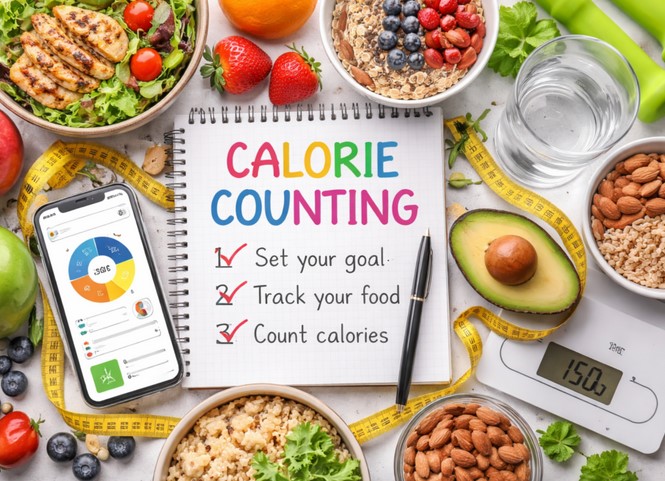
I once worked with a client, Sarah, who was convinced she was “metabolically broken.” She ate organic, avoided gluten, and drank green juice every morning, yet the scale wouldn’t budge. When we finally sat down to track her intake for just three days, we discovered her “healthy” afternoon snack of almond butter and granola was clocking in at 800 calories—nearly half her daily requirement.
In my ten years of health coaching and clinical observation, I’ve seen this story a thousand times. People aren’t failing because they lack willpower; they are failing because they are flying a plane without a fuel gauge. Calorie counting is often maligned as obsessive or outdated, but when used correctly, it is the most objective “fuel gauge” we have for the human body.
The Budgeting Analogy: Why Calories Matter
Think of your daily energy needs like a financial budget. If you earn $2,000 a month but spend $2,500, you end up in debt. In biological terms, “debt” is stored as adipose tissue (fat). Conversely, if you spend less than you earn, you draw from your savings.
Calorie counting is simply the act of balancing your checkbook. It’s not about restriction or punishment; it’s about awareness. Most of us are “financial illiterates” when it comes to the energy density of our food. Tracking provides the data necessary to make informed trades—like deciding if that gourmet cupcake is worth the “cost” of a smaller dinner later.
Understanding the Science of Energy Balance
To use calorie counting effectively, you have to understand where those numbers come from. Your body doesn’t just burn fuel when you’re at the gym; it’s a 24/7 furnace.
1. Basal Metabolic Rate (BMR)
This is the energy your body requires just to keep the lights on—breathing, circulating blood, and cell repair. Even if you stayed in bed all day, you’d still burn a significant number of calories.
2. Total Daily Energy Expenditure (TDEE)
This is the “magic number.” It combines your BMR with your physical activity and the Thermic Effect of Food (TEF)—the energy required to digest what you eat. To lose weight, you must consume fewer calories than your TDEE. To gain, you consume more.
3. Macronutrients: Not All Calories are Created Equal
While a calorie is a unit of heat energy ($1\text{ kcal}$ is the energy needed to raise the temperature of $1\text{ kg}$ of water by $1^\circ\text{C}$), your body processes different sources differently.
-
Protein: High TEF, keeps you full.
-
Carbohydrates: Primary fuel for high-intensity movement.
-
Fats: Essential for hormone production and nutrient absorption.
The Strategic Benefits of Calorie Counting
In my practice, I’ve found that the psychological benefits of tracking often outweigh the physiological ones.
-
Eliminating Guesswork: Most people underestimate their calorie intake by 30% to 50%. Tracking brings the “invisible” calories (like the oil used for cooking or the cream in your coffee) into the light.
-
Flexibility: Unlike restrictive diets that ban entire food groups, calorie counting allows for “discretionary spending.” You can eat pizza, provided it fits within your daily energy budget.
-
Objective Troubleshooting: When a weight loss plateau hits, data allows us to adjust. Without a log, we are just guessing whether we need to move more or eat less.
[Image showing a comparison of 200 calories in different food types like broccoli vs. peanut butter]
How to Start Calorie Counting Without Losing Your Mind
If you’re a beginner, the thought of weighing every blueberry can feel overwhelming. I always tell my clients to start with a “Data-Only Phase.”
Step 1: Find Your Baseline
Use an online calculator to estimate your TDEE. Be honest about your activity level; most people overrate how much they move.
Step 2: Choose Your Tool
Digital apps like MyFitnessPal, Cronometer, or Lose It! have massive databases. They make calorie counting as simple as scanning a barcode.
Step 3: Weigh, Don’t Guess
This is where the “Expert Insight” comes in. A “tablespoon” of peanut butter measured with a regular dinner spoon is often actually two tablespoons. For the first two weeks, use a digital food scale. It’s eye-opening and provides the “calibration” your brain needs to eventually estimate portions accurately.
Technical Context: Vocabulary for the Intermediate Tracker
As you move beyond the basics, you’ll encounter these terms in the health community:
-
Caloric Density: The number of calories per volume of food. (e.g., spinach has low density; butter has high density).
-
Net Carbs: Total carbohydrates minus fiber and sugar alcohols.
-
Non-Exercise Activity Thermogenesis (NEAT): Energy burned through fidgeting, walking to the car, or standing—often more impactful than a 30-minute workout.
-
Energy Homeostasis: The complex biological process by which the brain and body regulate food intake and energy expenditure.
Expert Advice and Hidden Warnings
The “Hidden Warning”: Beware of “Ghost Calories.” Condiments, salad dressings, and liquid calories (soda, juice, alcohol) are the most common reasons why people fail at calorie counting. A “healthy” salad can easily jump from 300 to 800 calories with a few heavy pours of ranch dressing.
Tips Pro: Focus on “Volume Eating.” If you are hungry while in a calorie deficit, prioritize foods with high water and fiber content (like leafy greens, cucumbers, and berries). These allow you to eat a large volume of food for very few calories, tricking your stomach’s stretch receptors into feeling full.
Is Calorie Counting for Everyone?
I would be remiss if I didn’t mention that tracking isn’t a permanent lifestyle for everyone. For those with a history of disordered eating, the focus on numbers can be triggering.
However, for the average person looking to gain control over their health, I view calorie counting like training wheels on a bicycle. You use them to learn the balance of energy and portions. Eventually, you develop “intuitive eating” skills because you finally understand the value of what’s on your plate.
Summary: Data is Empowerment
We live in an environment designed to make us overeat—super-sized portions and hyper-palatable processed foods are everywhere. In this landscape, calorie counting is your shield. It moves you from a place of “hoping” for results to “knowing” you are on the right path.
It’s not about being perfect; it’s about being aware. When you know the numbers, you hold the power.
Have you ever tried tracking your food for a full week? What was the most surprising thing you discovered about your eating habits? Share your “lightbulb moment” in the comments below—I’d love to hear what surprised you most!