It is 2:00 AM on a stormy Friday night. Suddenly, the blaring shriek of a smoke alarm slices through the darkness, followed immediately by a total power blackout. Your house is pitch black, your kids are crying in the next room, and thick smoke is beginning to accumulate near the ceiling. You have exactly 90 seconds to get your family out safely. Where is your flashlight? Where are your critical documents? Do you even know your primary exit path?
If your stomach dropped just reading that scenario, you are experiencing the psychological reality of being caught off guard.
Over my ten years of working as a public health writer and safety consultant, I have audited corporate disaster protocols and helped hundreds of families assess their household safety. The most sobering insight I have gathered from a decade in the field is this: When a crisis strikes, your cognitive capacity drops by up to 80% due to an immediate flood of adrenaline.
You do not magically rise to the occasion; instead, you sink to the level of your training and organization.
Yet, despite an increase in extreme weather events and unexpected municipal infrastructure failures worldwide, over 60% of households do not possess a basic disaster plan. True safety isn’t about giving in to fear or hoarding years of canned goods; it is about building a practical framework. Let us look at the technical data and actionable strategies behind effective emergency preparedness planning so you can protect your household before the unexpected happens.
The Insurance Policy Analogy: Why We Plan Ahead
Many intermediate clients I consult with treat disaster readiness like a superstitious taboo. They worry that by actively preparing for a crisis, they are somehow manifesting bad luck into their lives.
Let us dismantle that mindset with a simple analogy. Think of emergency preparedness planning exactly like carrying a spare tire in the trunk of your car, or keeping a fire extinguisher tucked under your kitchen sink.
[No Plan]   --> Crisis Strikes --> Panic, Chaos, & Complete Vulnerability
[Prepared]  --> Crisis Strikes --> Executing a Pre-Built Script with Calm Confidence
You do not buy a car insurance policy because you are secretly planning to crash your vehicle into a wall tomorrow morning. You buy it so that if a crash occurs, the financial impact doesn’t ruin your life. A physical readiness plan functions as operational insurance for your family’s physical survival. It transforms a terrifying, chaotic emergency into an organized, step-by-step script that you execute with calm confidence.
The Anatomy of an Emergency: Understanding the Core Pillars
To build an airtight system, your emergency preparedness planning must account for two distinct scenarios: Bugging Out (evacuating your home immediately due to imminent danger like a fire or flash flood) and Sheltering in Place (surviving inside your home without access to electricity, running water, or external supply chains during a major storm or grid collapse).
A professional-grade readiness framework relies on three fundamental technical pillars:
1. The Redundant Communication Matrix
During a widespread regional crisis, cellular networks experience severe traffic congestion, leading to systemic network failure. Your plan must include an out-of-state emergency contact. Local lines might be down, but long-distance text routing often remains operational. Furthermore, secure a hand-cranked NOAA weather radio to receive real-time updates directly from emergency management agencies when the internet collapses.
2. The Clean Water Hierarchy
The human body can survive for weeks without food, but dehydration will degrade your cognitive and physical faculties within three days. In a grid collapse, municipal water treatment plants can fail, introducing dangerous waterborne pathogens into the supply line.
Your plan requires a minimum of one gallon of water per person, per day, stored in BPA-free containers. Half of that gallon is strictly for hydration, while the other half is reserved for basic sanitation and hygiene.
3. The Digital Vault
Physical paper documents are incredibly vulnerable to water damage and fire. Create a secure digital vault by scanning your vital records—including passports, birth certificates, medical insurance policies, and property deeds—onto an encrypted, waterproof USB drive that lives inside your evacuation kit.
Building the Toolkit: The Scannable “Go-Bag” Checklist
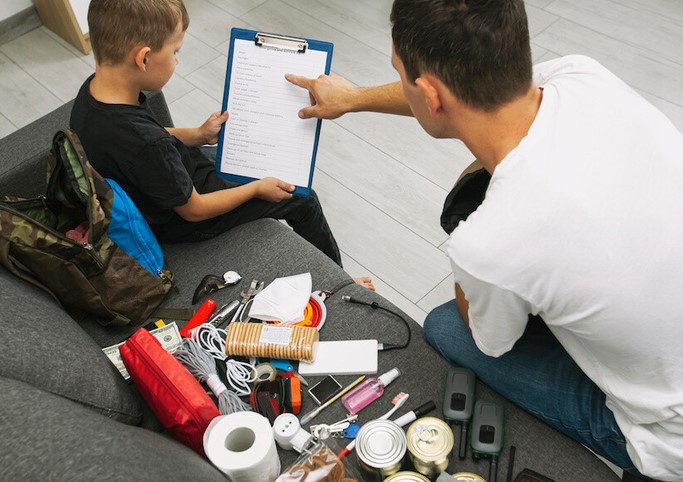
If you are forced to evacuate your home in under two minutes, you cannot waste time packing a suitcase. You need a dedicated, pre-packed 72-hour survival kit (commonly known as a Bug-Out Bag) sitting near your primary exit door.
Here is the exact hardware checklist I recommend for a highly functional kit:
-
Illumination and Power: A reliable LED headlamp (keeps your hands free), extra lithium batteries, and a solar-powered portable power bank.
-
First Aid and Medical Supplies: A comprehensive trauma kit containing sterile gauze, tourniquets, antiseptic wipes, and a minimum 7-day supply of life-essential prescription medications.
-
Thermal Protection: Lightweight, windproof emergency space blankets and heavy-duty ponchos to prevent hypothermia.
-
Tools and Utility: A high-quality multi-tool, a roll of heavy-duty duct tape, and a pack of waterproof matches or a ferrocerium striking rod.
-
Non-Perishable Nutrition: High-calorie, shelf-stable food bars or MREs (Meals Ready-to-Eat) that do not require cooking, boiling water, or refrigeration.
💡 Pro-Tip: The “Cash is King” Hidden Reality
Here is a crucial piece of insider operational advice: Keep a stash of small-denomination cash ($1, $5, $10, and $20 bills) hidden inside your emergency kit. During a widespread power outage or cyberattack, electronic point-of-sale (POS) systems, credit card terminals, and ATMs will go completely dark. A $100 bill is useless if a local merchant cannot give you change for a gallon of gas or a case of water. Small cash bills ensure you can still trade for essential resources during a localized financial blackout.
Household Orchestration: Creating Your Family Protocol
A brilliant plan written down on a piece of paper is completely useless if the rest of your household doesn’t know it exists. Once you have built your kits, hold a brief family safety meeting to establish clear operational boundaries.
The Ultimate Readiness Blueprint: A Quick-Reference Summary
To keep your family’s safety protocol fully optimized throughout the year, utilize this scannable lifestyle matrix:
| Maintenance Pillar | Action Item | Schedule |
| Food & Water Rotation | Check expiration dates on shelf-stable rations; cycle your emergency water bottles into regular use. | Every 6 Months |
| Battery Diagnostics | Test the charge levels on your flashlights, radios, and backup power banks. | Every 3 Months |
| Medical Audit | Swap out prescription medications in your go-bag to prevent structural degradation. | Annually |
| Plan Re-evaluation | Update contact numbers, address changes, and emergency meeting points with your household. | Annually |
The Final Verdict: Peace of Mind Beats Panic
After more than a decade of studying human behavior during crises, analyzing disaster metrics, and working alongside emergency managers, my ultimate conclusion is unshakeable. True emergency preparedness planning is not born out of paranoia; it is born out of profound self-respect and love for your family.
You cannot control when an earthquake will strike, when a severe winter storm will collapse the local electrical grid, or when a water main will burst in your neighborhood. But you have absolute control over how your household responds to that event. By taking small, methodical steps today—packing a basic go-bag, securing a clean water supply, and mapping out clear exit protocols—you strip away the power of panic and replace it with decisive, life-saving control.
Now, I Want to Hear From You!
Do you currently have a basic emergency kit set up in your home, or have you been waiting for the “perfect time” to get started? If you have ever lived through a major blackout or natural disaster, what was the one item you wished you had on hand? Drop your thoughts, questions, or kit ideas in the comments section below—I read every single response and am here to help you build your plan!