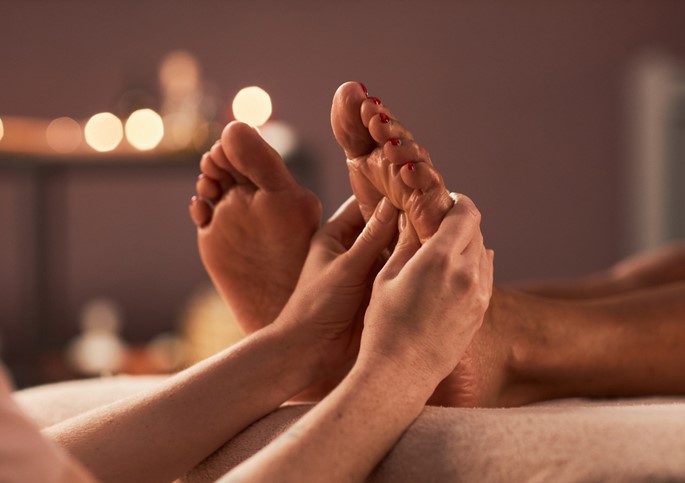
You’ve spent eight hours on your feet, or perhaps squeezed into dress shoes that look great but feel like medieval torture devices. By the time you get home, your feet aren’t just tired—they feel “heavy,” throbbing with a dull ache that seems to radiate all the way up to your lower back. Most people reach for an aspirin or a hot soak. But what if the map to fixing that back pain, calming your racing mind, or even settling your digestion was literally printed on the soles of those aching feet?
In my twelve years of exploring integrative medicine, I’ve transitioned from a skeptic to a staunch advocate of foot therapy. I remember my first professional session: the therapist pressed a specific spot on my inner arch, and I felt a strange, cooling sensation in my mid-back—the exact spot where I’d been carrying a knot for weeks. It wasn’t magic; it was the biological “switchboard” of the body in action.
The Reflexology Health Benefits we discuss today go far beyond a simple foot massage. We are talking about a sophisticated system of manual therapy that taps into the nervous system to encourage the body’s self-healing mechanisms.
The “Circuit Breaker” Analogy: How Reflexology Works
To understand reflexology, think of your body as a complex smart home. When a light goes out in the attic (your head) or the heater fails in the basement (your digestion), you don’t always have to go to that specific room to fix it. Instead, you go to the breaker box in the garage.
In this analogy, your feet, hands, and ears are the breaker boxes. By applying pressure to specific “reflex points,” a therapist sends an electrochemical signal through the peripheral nervous system to the central nervous system. This signals the brain to adjust the “current” (blood flow and energy) to the corresponding organ or zone.
The Core Reflexology Health Benefits for Modern Living
While the practice is ancient, the modern clinical applications are more relevant than ever. Here is how this therapy specifically supports your physiology.
1. Stress Reduction and Cortisol Management
Our bodies are often stuck in “Sympathetic Overdrive”—the fight-or-flight state. Reflexology is a powerful tool for triggering the Parasympathetic Nervous System (rest and digest).
-
The Insight: I’ve observed that during a session, a client’s heart rate variability (HRV) often improves significantly within the first fifteen minutes.
-
The Result: A deep sense of relaxation that lowers blood pressure and reduces the systemic inflammation caused by chronic stress.
2. Enhanced Blood Circulation and Nerve Function
The feet are the furthest point from the heart. Gravity makes it difficult for blood to “climb” back up efficiently, which is why we get swelling.
-
The Benefit: Reflexology stimulates over 7,000 nerve endings in each foot. This “wakes up” the neural pathways and encourages vasodilation.
-
LSI Connection: This is particularly beneficial for those managing peripheral neuropathy or sluggish lymphatic drainage.
3. Pain Management and the Gate Control Theory
How can pressing a toe help a headache? It involves the Gate Control Theory of Pain. By stimulating non-painful nerve fibers through pressure, the “gate” in the spinal cord closes to painful signals coming from other parts of the body.
-
Key Area: Targeting the “ball of the foot” (the lung/chest area) or the “great toe” (the head/brain area) can provide relief for tension headaches and respiratory tightness.
Deep-Dive into the “Zone Theory”
Reflexology is built on Zone Theory, which divides the body into ten vertical longitudinal zones. There are five zones on each side of the body, ending in the five fingers and five toes.
When a reflexologist works on your right foot, they are addressing the right side of your body. If you have a gallbladder issue, they will focus on the right foot; if it’s a spleen issue, the left. This structural mapping is what separates a “pampering massage” from a therapeutic reflexology session.
Expert Advice: Insights from a Decade in Health
Through years of practice and observation, I’ve identified a few “hidden” aspects of reflexology that you won’t find in a basic brochure.
-
Tips Pro: The “Water Rule.” Reflexology stimulates the lymphatic system to dump metabolic waste into the bloodstream. If you don’t drink at least 500ml of water immediately after a session, you might experience a “healing crisis”—a mild headache or fatigue as those toxins sit in your system.
-
“Tenderness” isn’t bad, but “Sharp Pain” is. If a spot on your foot feels like a bruise or a grain of sand, it often indicates a blockage or congestion in the corresponding organ. However, if a therapist is pressing so hard you are tensing up, the therapy backfires. You cannot “force” a nervous system to relax.
-
The Pregnancy Note: If you are in your first trimester, always seek a specialist. Certain points near the ankle (the uterus and ovary reflexes) are thought to stimulate contractions and should be handled with extreme care.
Scannable Checklist: Maximizing Your Session
To get the most out of the Reflexology Health Benefits, use this protocol:
-
Dress Comfortably: Wear loose pants that can easily be rolled up to the knee. The therapist often works on the lower calf to address the sciatic nerve.
-
Communicate Tenderness: Don’t be a hero. Tell your therapist if a spot feels “crunchy” or sensitive. That is data they need to adjust their map.
-
Observe Your Reactions: It is common to feel cold, experience “tummy gurgling,” or feel incredibly sleepy during a session. These are all signs your body is shifting into a healing state.
-
Frequency Matters: For chronic issues like insomnia or digestive distress, one session is a band-aid. A series of 4–6 weekly sessions is usually where the long-term biological shifts happen.
Integrating Reflexology into Your Lifestyle
You don’t always need a professional to reap the rewards. While a practitioner provides the most depth, “Self-Reflexology” is a valid maintenance tool.
-
The Golf Ball Trick: Keep a golf ball under your desk. Roll your arch over it for five minutes. This targets the solar plexus reflex, the center for emotional stress, helping you stay grounded during a hectic workday.
-
Epsom Salt Synergy: Follow your session with an Epsom salt soak. The magnesium absorption through the skin works in tandem with the opened neural pathways to double the muscle-relaxing effect.
Conclusion: Step Into Better Health
The Reflexology Health Benefits are a testament to the body’s interconnectedness. We often view our health as a series of isolated parts—a stomach problem here, a back problem there. Reflexology reminds us that we are a single, continuous electrical system.
By paying attention to our feet, we are essentially listening to the “early warning system” of the entire body. Whether you are seeking relief from a specific ailment or just looking for a way to quiet the noise of a high-stress life, giving your “breaker box” some attention might be the best step you take all year.
Have you ever noticed a specific spot on your feet that always feels tender when you’re stressed? Or have you had a “surprising” reaction to a foot massage before? Share your thoughts and experiences in the comments below!