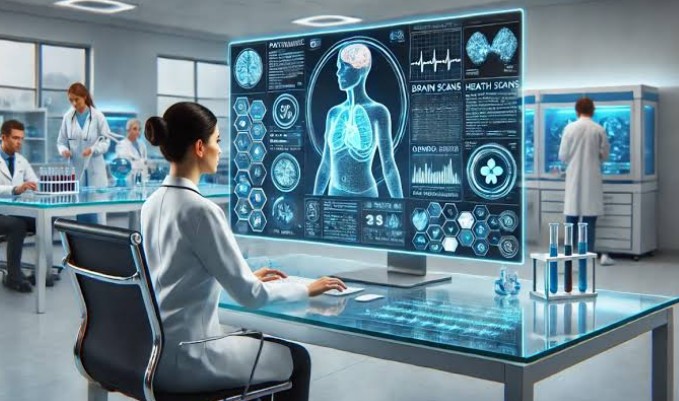
A tired radiologist sits in a dimly lit basement reading room at 2:00 AM, reviewing her 140th chest CT scan of the night. Her eyes are dry, her focus is waning, and hidden deep within the lower lobe of a patient’s left lung lies a microscopic 3-millimeter shadow—a early-stage malignant nodule easily missed by human fatigue. Seconds later, a subtle blue box highlights the exact anomaly on her screen, flagged with a 98.4% probability score for early intervention.
Over my ten years as a health and clinical technology writer, I have stood in research labs and hospital units across the globe watching this exact scene transform from science fiction into everyday practice. Early on, clinicians were terrified that algorithms were coming to steal their jobs.
However, spending time alongside computer scientists and diagnostic specialists taught me the real truth: AI in medical diagnostics isn’t replacing human doctors. It is providing them with a supercharged digital microscope, catching micro-patterns in human tissue that the naked eye was never designed to perceive.
Whether you are a patient curious about modern hospital tech or a healthcare worker navigating digital medicine, here is what you need to know about how artificial intelligence is rewriting the rules of clinical detection.
How AI Diagnostics Actually Works: Demystifying the Algorithm
To understand why this shift is so revolutionary, we need to demystify what happens under the digital hood when an algorithm reads a medical image or fluid panel.
Think of diagnostic AI like an expert master proofreader who has memorized every single book ever written in human history. If you give a human editor a 1,000-page manuscript, they might catch 95% of typos, but fatigue will cause them to miss microscopic errors buried on page 742. The AI proofreader scans all 1,000 pages in half a millisecond, comparing every punctuation mark against millions of historical references simultaneously.
+------------------------------------+---------------------------------------------------------------+
| AI Diagnostic Modality             | How Machine Learning Enhances Clinical Accuracy              |
+------------------------------------+---------------------------------------------------------------+
| Computer Vision (CNNs)             | Detects sub-visual cellular irregularities in scans/X-rays    |
| Natural Language Processing (NLP)  | Scans unstructured EHR records for hidden disease risk factors|
| Predictive Pattern Recognition     | Analyzes multi-omic data to predict sepsis or cardiac arrest  |
| Liquid Biopsy Analytics            | Identifies circulating tumor DNA fragments in blood samples   |
+------------------------------------+---------------------------------------------------------------+
In medical imaging, scientists utilize Convolutional Neural Networks (CNNs)—deep learning algorithms trained on millions of anonymized X-rays, MRIs, and pathology slides. The AI breaks down images into tiny pixel arrays, analyzing color contrast, edge density, and structural anomalies far faster and more precisely than any human brain could process.
4 Key Medical Specialties Transformed by AI
The footprint of AI in medical diagnostics spans almost every major clinical department. Here is where machine learning is making its biggest real-world splash:
1. Radiology and Diagnostic Imaging
-
The Breakthrough: Automated triaging of acute emergency scans.
-
Clinical Impact: Algorithms rapidly scan emergency room CT outputs for intracranial hemorrhages, pulmonary embolisms, and spinal fractures. High-risk scans jump to the top of the radiologist’s queue instantly, cutting critical diagnostic turnaround times from hours to minutes.
2. Digital Pathology and Oncology
-
The Breakthrough: High-throughput tissue analysis.
-
Clinical Impact: Pathologists no longer have to spend hours counting cancerous cells manually on glass slides. AI algorithms stain, segment, and quantify malignant cell density in biopsy tissue with extreme mathematical precision, aiding in accurate cancer staging.
3. Cardiovascular Risk Prediction
-
The Breakthrough: Non-invasive electrocardiology analysis.
-
Clinical Impact: Modern AI models evaluate subtle electrical waveform variations on standard 12-lead ECGs to predict hidden arrhythmias, structural heart disease, or heart failure risk years before physical symptoms manifest.
4. Dermatology and Early Melanoma Detection
-
The Breakthrough: High-resolution dermatoscopic visual scoring.
-
Clinical Impact: Smartphone-integrated AI vision tools assist dermatologists by capturing high-resolution photos of suspicious skin lesions, comparing pigment distribution and asymmetrical borders against massive dermatological image banks.
The Human-Machine Partnership: Augmentation, Not Automation
A major misconception among beginners is the fear that AI systems will make independent medical decisions without human oversight. In actual clinical workflows, AI operates under a “human-in-the-loop” framework:
                  +-----------------------------------+
                  |        PATIENT DIAGNOSIS          |
                  +-----------------+-----------------+
                                   / \
                                  /   \
                                 /     \
                                v       v
  +---------------------------------+   +---------------------------------+
  |      ALGORITHMIC ANALYSIS       |   |      CLINICAL JUDGMENT          |
  | High-speed pattern recognition, |<->| Contextual reasoning, patient   |
  | anomaly scoring, data triaging  |   | history, empathetic care plan   |
  +---------------------------------+   +---------------------------------+
Algorithms excel at processing massive datasets, recognizing subtle visual markers, and calculating statistical probabilities. Humans excel at contextual understanding, complex physical examinations, and empathetic communication. When combined, medical diagnostic error rates plummet significantly compared to either doctors or AI working in isolation.
Pro Tips & Hidden Warnings from a Health Insider
Pro Tip: Ask If Your Imaging Center Uses AI Triage
If you are scheduling preventive screenings like a mammogram, lung screening, or routine cardiac CT, ask your provider if their imaging network integrates FDA-cleared AI diagnostic tools. Facilities utilizing dual AI-radiologist double-read workflows consistently show higher sensitivity rates for early-stage lesion detection.
The Danger of “Algorithmic Bias” and Black-Box Models
Machine learning models are only as good as the data used to train them. If an AI algorithm is trained predominantly on patient data from affluent suburban populations, its diagnostic accuracy may drop when evaluating patients from diverse racial, ethnic, or socioeconomic backgrounds. Healthcare systems must demand transparent, broadly validated training datasets to prevent systemic diagnostic disparities.
4 Steps for Patients and Providers Navigating the Future
-
Embrace Digital Record Accessibility: Use patient portals to centralize your lab results, imaging reports, and electronic health records (EHRs)—making it easier for predictive tools to aggregate your health metrics accurately.
-
Prioritize Data Privacy: Ensure any health app or diagnostic platform you interact with adheres to strict data encryption standards (such as HIPAA compliance) to safeguard your sensitive genetic and medical data.
-
Verify FDA Clearances: Not all consumer health algorithms are created equal. Look for medical AI software that holds formal regulatory clearance (such as FDA 510(k) or CE mark certification) for clinical diagnostic support.
-
Maintain Open Dialogue with Your Physician: Treat AI outputs as powerful conversational starting points rather than absolute medical truth. Always discuss diagnostic findings directly with a qualified healthcare professional.
The rise of AI in medical diagnostics marks one of the most exciting shifts in modern medical history. By taking over heavy data processing and spotting hidden disease markers early, smart technology gives doctors back their most valuable gift: time to focus on compassionate, personalized patient care.
How do you feel about AI playing a role in your medical diagnoses—are you excited for higher accuracy or cautious about digital medicine? Share your thoughts, questions, or personal experiences in the comments below!