Imagine waking up in the morning, reaching for your phone to check your messages, and noticing the text looks just a bit blurrier than usual. Or perhaps after eight hours of staring at a computer screen, your eyes feel hot, dry, and gritty, as if fine sand is trapped behind your lids. We often treat our eyesight as a given—until the moment our clarity begins to fade.
In my decade as a health writer, working alongside leading ophthalmologists, I’ve witnessed one recurring mistake: most people only start caring about their eyes when they need a thicker lens prescription. However, what you put on your plate tonight directly dictates how sharp your vision will be ten years from now. We aren’t just talking about carrots; we are talking about nutrient bioavailability that can actually cross the blood-retinal barrier.
Today, we are going deep into the role of Foods for Eye Health to keep your windows to the world clear and vibrant.
Why Your Eyes Crave Specific Nutrients
The eye is one of the most metabolically active organs in the human body. It is constantly bombarded by oxidative stress from blue light and UV rays. If our body were a city, the eyes would be the command center that consumes the most electricity.
The Camera Filter and Sensor Analogy
Think of your eyes like a high-end digital camera. The front lens must stay crystal clear, and the sensor at the back (the retina) must stay sensitive yet protected. The nutrients we eat act as both the “lubricant” for that lens and the “shield” for that sensor. Without the right intake, the sensor wears out prematurely, and the images produced become grainy, dim, or filled with dark spots.
Key Components in Foods for Eye Health
To understand the grocery list we are about to build, we need to meet the “superheroes” working behind the scenes. These are the nutrients that must be on your radar:
1. Lutein and Zeaxanthin (Your Internal Sunglasses)
These two carotenoids are concentrated in the macula—the small part of the retina responsible for detailed central vision. I like to call them “internal sunglasses.” They absorb harmful blue light before it can damage your photoreceptor cells.
2. Omega-3 Fatty Acids (DHA & EPA)
I often hear patients complain about dry eyes after working in air-conditioned offices. Usually, the problem isn’t a lack of tears, but poor tear quality. Omega-3s help the meibomian glands produce the essential oil layer that prevents tears from evaporating too quickly.
3. Vitamins C and E (The Anti-Rust Team)
Oxidation is the primary enemy of eye tissue. These vitamins work like a cleanup crew that neutralizes free radicals, preventing the clouding of the lens known as cataracts.
The Ultimate Grocery List for Sharp Vision
Let’s get practical. What should actually be in your shopping cart?
Dark Leafy Greens (The Powerhouses)
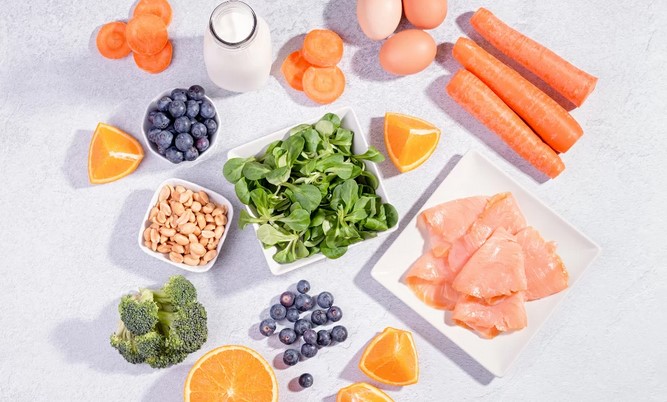
Spinach, kale, and collard greens are more than just plate fillers. They are the primary sources of lutein and zeaxanthin.
-
Expert Insight: Your body absorbs lutein much better when these greens are lightly cooked and eaten with a healthy fat (like olive oil or avocado), as lutein is fat-soluble.
Fatty Fish (The Lubricator)
Salmon, tuna, and sardines contain high concentrations of DHA. Interestingly, the retina is actually composed of a high percentage of DHA. Eating fish at least twice a week significantly lowers the risk of Age-Related Macular Degeneration (AMD).
Eggs (Nature’s Multivitamin)
Never skip the yolk. Egg yolks contain zinc, which helps Vitamin A travel from the liver to the retina to produce melanin, a protective pigment in the eyes.
Berries and Citrus
Strawberries, blueberries, and oranges are packed with Vitamin C. This vitamin supports the health of the tiny, delicate blood vessels in the eye, ensuring a steady flow of nutrients and oxygen.
Strategies to Combat Digital Eye Strain
In our modern era, Foods for Eye Health may not be enough if they aren’t paired with good habits. As someone who spends hours writing in front of a screen, I swear by the “20-20-20 rule.”
Every 20 minutes, look at something 20 feet away for at least 20 seconds. This allows the ciliary muscles in the eye to relax, while the nutrients in your bloodstream work to repair the oxidative stress caused by focused blue-light exposure.
Pro Tip: Don’t rely solely on supplements. Whole foods contain “co-factors” that help absorption much more efficiently than synthetic pills. If you want maximum results, get your nutrition from a plate, not a plastic bottle.
The Hidden Warning: The Kitchen Enemies of Vision
Many people focus on what to eat but forget what to avoid. Excess sugar is the number one enemy of the eye.
Chronically high blood sugar can cause the lens of the eye to swell and damage the micro-vasculature in the retina, which is the precursor to diabetic retinopathy. If you want to protect your sight, limiting refined carbs and added sugars is just as important as eating your spinach.
A Simple Meal Plan for Clearer Sight
Here is a sample daily menu designed to optimize your visual health:
-
Breakfast: Egg omelet with spinach and a side of tomatoes (Lutein + Zinc combo).
-
Lunch: Grilled salmon salad with a lemon-tahini dressing (Omega-3s + Vitamin C).
-
Snack: A handful of almonds or walnuts (Vitamin E).
-
Dinner: Stir-fried broccoli and lean beef or tofu (Vitamin A + Zinc).
Conclusion: Investing in Your Future Sight
Protecting your eye health isn’t about drastic overnight changes; it’s about the consistency of your nutritional choices. By incorporating a variety of Foods for Eye Health into your daily routine, you are providing long-term protection against degenerative diseases that can strip away your independence in your later years.
Our eyes are the windows that show us the beauty of the world. Don’t let those windows get cloudy due to a lack of internal maintenance. Start with one small change today—perhaps adding a serving of greens to your dinner or swapping a sugary snack for a bowl of berries.
How are your eyes feeling today? Have you noticed a difference when you change your diet, or do you have a favorite vision-boosting recipe? Share your thoughts in the comments below. Let’s keep our vision sharp together!
Disclaimer: This article is for informational and educational purposes only and does not replace professional medical advice. Always consult with an ophthalmologist or a registered dietitian before making significant changes to your diet.